Pages

Sunday, 7 June 2015

Photo of the Month: May 2015

BRANCH LINE
Branch line

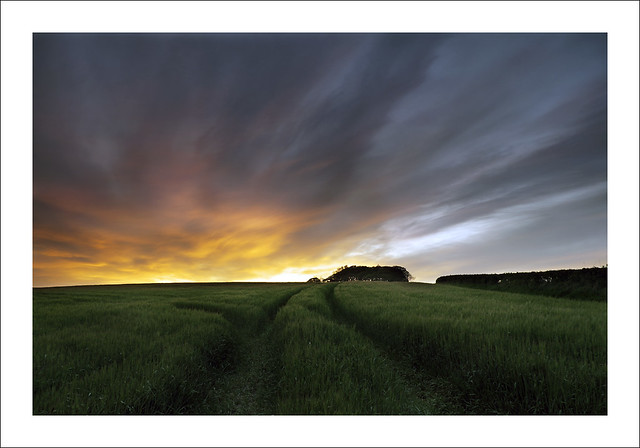
 22nd May 2015, Crombie, Fife

May this year has seen some very moody skies at sunset in western Fife. Fortunately I have a few very local spots where I can watch a sky develop from my car and decide how I am going to shoot it.  Sometimes I use small country lanes as my foreground lead-in but with the recent sunny weather the crops are now maturing and this allows me to use the tractor lines in the fields as a lead-in. Tonight's sunset was another spectacular one and the field is less than a mile from home.  
The image presented a challenge due to the large dynamic range between the shadow areas and the highlights in the sky on the horizon. In these situations I initially ignore the extreme highlights and bracket 3 exposures metering off the foreground, using a graduated neutral density filter to balance the sky. A 4th exposure was taken from a spot meter reading just above the horizon to capture the highlight detail.  The final image was manually blended from three of the four images taken using layer masks in Photoshop. 


Technical Info:

Taken with a Fujifilm X-T1
Fujinon XF 18-135mm f/3.5-5.6 R LM OIS WR lens @ 18mm
EXIF: ISO-200 / f/8 / 1/3 sec / 1/15 sec / 2/3 sec, 3 exposures blended
Lee filters: 
RAW File converted to TIFF in Fuji RAW converter powered by Silkypix, developed in Adobe PSE9


Website  /  Profile

Sunday, 19 April 2015

Behind the shot: Wildcamp on Goatfell, Isle of Arran


This image was entered into WEX Photographic's weekly photography competition on Twitter called #WexMondays (20th April 2015) and they invited me to share a 'behind the shot' blog explaining why I chose it for #WexMondays, the gear and setting I used, post processing done and to give it a difficulty rating.

One of my objectives for 2015 is to take photography with me into wild places.  They may be places that are within easy reach of roads and settlements, or off the beaten track in more remote areas.  All will involve some form of hiking in/out and some will require an overnight stay in the form of a wild camp.

This was to be my first wild camp of the year, in fact, it's been a long time since I had done any wild camping.  I chose Arran because it started with 'A' and because I had never been there.  In tourist guides it is described as 'Scotland in Miniature' but what really drew me were the Arran Hills.  The highest is Goatfell which, at 874 metres, is higher than Blencathra or Fairfield in The Lakes.  To the north and west of Goatfell are more peaks all connected by jagged ridges, the traverse of which is considered to be the finest of its type outwith The Cuillins on Skye.  A foray into the Arran Hills would make a fine photographic adventure in a wild place. 

Wild camping and photography present its own challenge as you have to decide what to take and what to leave; the trick being to keep the weight of your rucksack to a manageable level so that you don't wear yourself out.  In terms of camera gear I took the following in a small camera bag: Fuji X-E2 with 14mm and 23mm XF prime lenses, 2 spare batteries, a set of Lee RF75 ND Grad filters & holder and 2 cloths.  This went inside my rucksack whilst a Giottos Vitruvian tripod was strapped to the outside.

My plan was simple.  Drive from my home in Fife and get the CalMac ferry from Ardrossan in North Ayrshire to Brodick, Arran. Hike from the ferry terminal to the top of Goatfell via the 'tourist' path (8km / 5 miles each way), set up my camp on the summit, photograph the sunset, get up early the following morning to photograph the dawn and sunrise before returning to Brodick for the ferry back to Ardrossan and home.

So today I took a boat ride across the Firth of Clyde on the MV Caledonian Isles arriving at Brodick Pier at 1:30pm on a hot afternoon with clear blue skies.  There were hundreds of passangers already queuing for the next sailing to Ardrossan.  The pier was a hive of activity.  In contrast, 4 hours later I was alone on top of Goatfell and it was the view above that greeted me on arriving at the summit.  It took my breath away.  With three hours until sunset I had ample time to explore the summit, set up camp and do some photography in the early evening light.  During the golden hour the light was even better before the cloud blackened and thickened up.  The sun made one final appearance on the horizon just before it set.  The following morning I awoke to rain, hail, wind and hill fog and it didn't lift from the hills until the early afternoon so no dawn/sunrise was seen.  After re-loading my pack I headed down to Brodick passing the first walkers of the day in the fog about 30 minutes from the summit.  They wanted to know what time I had started as they were hoping that they would be the first up on top today.  Technically they would be the first, as I didn't touch the cairn or trig point before setting off and a good-hearted discussion followed on the merits of wild camping.  I was back home in Fife by mid-afternoon.

I used the Fuji XF 14mm lens with Fuji X-E2 plus tripod for all the images that evening using the 2 sec. timer instead of a remote release (saved a few grams here).  Focus was set manually using the Depth of Field markings on the lens barrel to set the hyper-focal distance.  This allowed me to meter using 'spot' metering without worrying that it would change the point of focus. I dialed in f/11 and let the camera select the shutter speed.  A Lee 0.6 or 0.9 GND filter balanced exposure in the sky.  The images were taken in the Fuji RAW format. 

Monday evening and I had to work quickly to get my image into #WexMondays on time. The Fuji software is still relatively new to me and I developed the RAW file in Silkypix electing to use the defaults for everything except colour, which I changed from Standard to Velvia2.  This boosted the hues and saturation and made the image pop.  I uploaded to Twitter late on Monday evening.

On Tuesday morning I looked at the image again and decided it was a slightly too dark and over-saturated so developed the RAW file again keeping the defaults but used the curves command to create an 'S' shaped tone curve to keep the shadows and brighten the mid-tones.  The Velvia2 simulation was too overpowering for this scene so this was swapped for Velvia1 giving a more natural look.  Photoshop was used for cropping and applying some output sharpening. The final image is shown below.

In terms of giving it a difficulty rating I would give it 7/10.  It wasn't winter, there was no snow on the ground and there was a good footpath all the way to the summit.  You do have to be committed, have a reasonable level of fitness and be confident in your ability to go into wild places without relying on the assistance of others.  When the conditions are right the images that can be got will speak for themselves.  They will offer the viewer a fresh perspective on the landscape that is now becoming more difficult to achieve because of the sheer number of people who frequent the photographic hot spots near roads looking to photograph the iconic views.  There is much to recommend in this approach. 


More images from the evening spent on the summit of Goatfell are shown below as a series of plates.  Larger copies can be viewed simply by clicking on them.


An interactive Google map centred on Brodick is given below.


I am an outdoor photographer based in western Fife where I have been living for over 18-years. I work purely in the digital format.  A very experienced mountain walker, having been introduced to the fells of the Lake District from an early age, I have spent over 20-years climbing the Munros and Corbetts of the Scottish Highlands.
Sunday, 12 April 2015

Photo of the Month: March 2015

TENTSMUIR
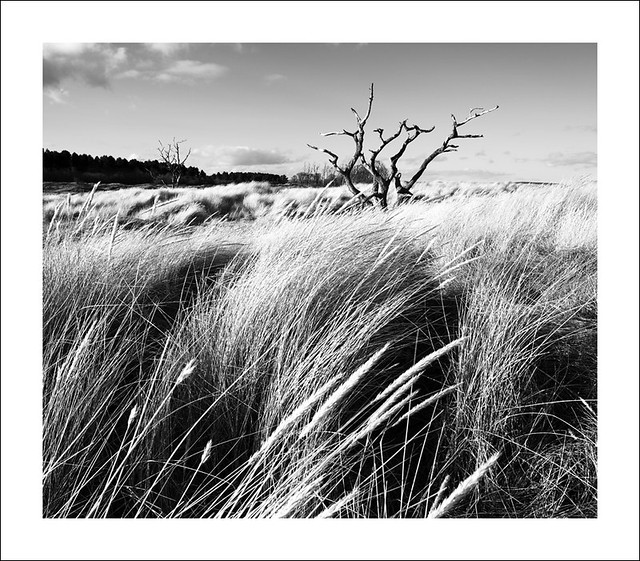
Tentsmuir

8th March 2015, Tentsmuir National Nature Reserve, Fife

Tentsmuir, on the north-east coast of Fife above St Andrews.  On an OS map it looks like many other Forestry Commission forests with a regular pattern of forest roads and uniform conifers. But on closer inspection it is different. Yes, the forest is extensive covering 14 sq km's, making it one of the largest forests in Fife, but it extends along the coast for 8km's with a line of sand dunes separating it from miles of sandy beaches. The coastline is now a National Nature Reserve, and the dune grasses are littered with decaying trees giving the appearance of a desert. The afternoon was sunny and unseasonably warm as we walked from the forest through the dunes and along the beach towards Tentsmuir Point.  On the return leg I knew what I wanted to photograph and I knew that black and white would give me the look I was wanting.  I wandered through the grasses until the right combination of light on dark appeared in the viewfinder.  I also wanted one of the decayed trees to provide a focal point.

 
Technical Info:

Taken with a Canon EOS 5D mkII
Zeiss Distagon T* 21/2.8 ZE lens
EXIF: ISO-100 / 1/60 sec / f/11 
Lee filters: 0.6 Hard GND
RAW File converted to TIFF in Canon DPP, developed in Adobe PSE9


Website  /  Profile

Sunday, 8 March 2015

Photo of the Month: February 2015

TRACK OF TURRET
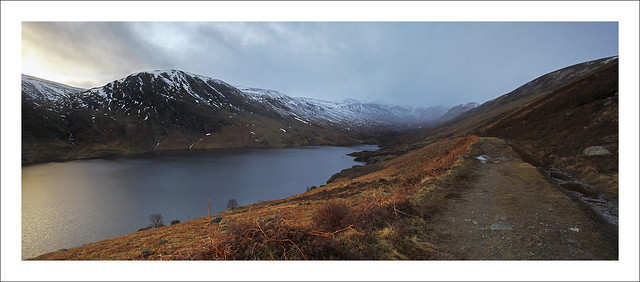
Track of Turret


20th February 2015, Loch Turret reservoir, Perthshire
  
Loch Turret at the head of Glen Turret in Perthshire.  It is a reservoir, 4km in length, with an access track running along its eastern side that ends in upper Glen Turret below the summit of Ben Chonzie. I had all four seasons in an afternoon. Sun, rain, snow, hill fog and lots of cloud. In the sky were eagles, buzzards and a red kite too. With an hour to go before sunset I watched cloud descend from the north along the loch, laden with snow. The dead bracken below the track was lit by the sun which would soon disappear as the cloud engulfed the loch creating a ghostly atmosphere. The final image was blended and stitched from 3 overlapping frames.   


Technical Info:

Taken with a Canon EOS 5D mkII
Zeiss Distagon T* 35/2 ZE lens
EXIF: ISO-100 / 1/15 sec / f/11 x 3 frames, stitched
Lee filters: 0.6 Soft GND
RAW File converted to TIFF in Canon DPP, developed in Adobe PSE 9

Website  /  Profile

Sunday, 8 February 2015

Photo of the Month: January 2015

DREICH DAY AT DYSART
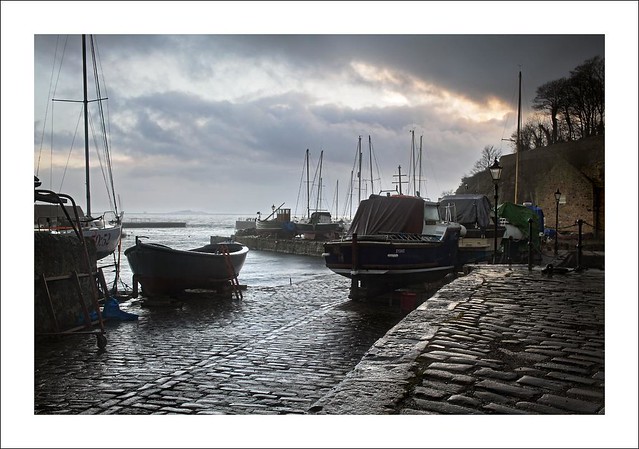
Dreich day at Dysart

23rd January 2015, Dysart harbour, Fife

The picturesque harbour at Dysart lies beneath a high wall of natural stone which offers protection from storms. With stone piers and buildings, cobbled surfaces, old sheds and cast iron lamps, it has the ambience of a bygone age. During the winter months many of the small craft line the piers. Soon after arriving today it started to rain. I sheltered as best I could, waiting for the rain to stop, even for a few minutes, but this was more in hope than anything else.  I resisted the urge to pack up and instead set up beside the Harbourmasters House using a small reflector as a makeshift umbrella to keep the lens and filters dry.  The rain has reflected light on both the cobbles and on some of the boats which is why I was reluctant to miss this opportunity as it has given the composition an ambience which would have been lost had it been dry. 

Technical Info:

Taken with a Canon EOS 5D mkII
Zeiss Distagon T* 35/2 ZE lens
EXIF: ISO-100 / 0.5 sec / f/11
Lee filters: 0.6 Hard GND
RAW File converted to TIFF in Canon DPP, developed in Adobe Photoshop CS5 with Topaz Adjust plug-in

Website  /  Profile


Sunday, 11 January 2015

Photo of the Month: December 2014

GLOAMING LIGHT, BEN A'AN - Shortlisted - OPOTY 2015
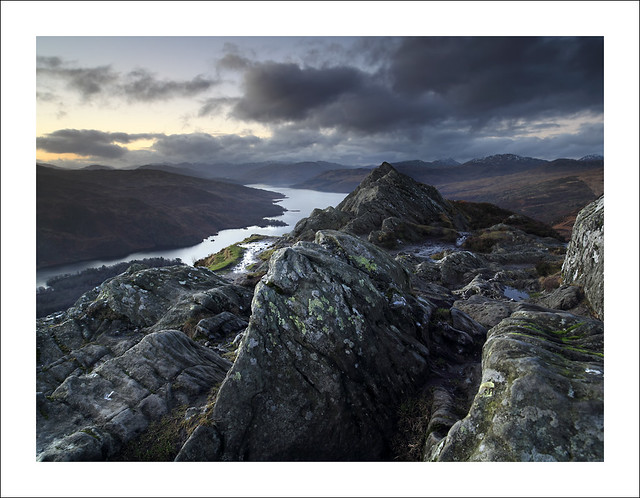
Gloaming light, Ben A'an


23rd December 2014, Ben A'an, The Trossachs

This was my fourth visit of the year to the summit of Ben A'an, this time a few days after the winter solstice.  I was motivated by my article on Ben A'an which has just been published in Outdoor Photography magazine - Issue 187.  I arrived to find both the Ben A'an car park and footpath closed due to forest operations on the lower slopes of Ben A'an.  Fortunately, work has ceased until Monday 5th January 2015 so restrictions have been eased until this date and both the car park and footpath have been re-opened for the holiday period. It took 45-mins to reach the top where, once again, I had the summit all to myself.  As on my last visit the sky was relatively clear, with the sun now setting in the south-west.  I used the summit rocks to fill the foreground.  The best light was the gloaming light, which lingered for 40 minutes after sunset.  The resultant image, whilst dark and moody still shows some of the lingering light.  I descended by torchlight.


Technical Info:

Taken with a Canon EOS 5D mkII
Zeiss Distagon T* 21/2.8 ZE lens
EXIF: ISO-100 / 4 sec / f/11
Lee filters: 0.6 Hard GND
RAW File converted to TIFF in Canon DPP, developed in Adobe PSE9

Outdoor Photography Magazine - Low Light Landscapes Challenge / runners-up - Issue 192 / June 2015

Shortlisted image - 'Light on the Land' category - Outdoor Photographer of the Year 2015

Website  /  Profile

Sunday, 14 December 2014

Photo of the Month: November 2014

Illumination - Shortlisted: SLPOTY 2014
Illumination, Callander Crags, The Trossachs


2nd November 2014, Callander Crags, The Trossachs

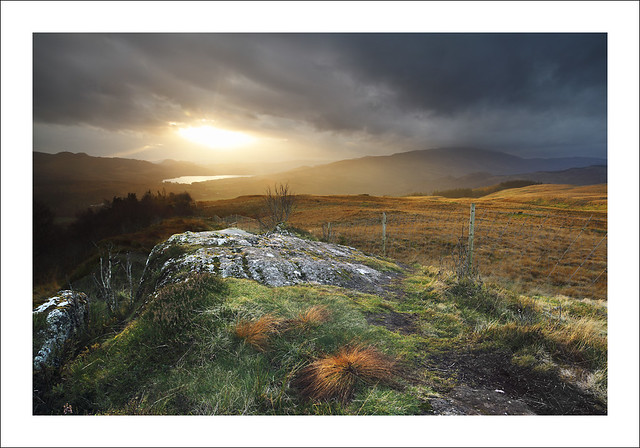
The waymarked Callander Crags walk behind Callander is fairly strenuous on steep gradients.  Officially it is closed, with a diversion in place, due to windblown trees blocking the path. Today was a dull and overcast day with thick cloud. We decided to ignore the diversion and use the original path to get to the crags but navigating through the trees was more like being on an assault course.  Hundreds of trees have been blown over as a result of a winter storm and it will take time to clear the fallen trees and re-instate the path. We arrived on the crags quite late in the afternoon to be greeted by thick cloud everywhere so decided to descend back to Callander on another path. But then quite unexpectedly the sun shone through a small gap in the clouds and illuminated everything with orange light.  It was quite magical and by working quickly I was able to record the scene before the sun disappeared for good. Loch Venachar is below the sun with Ben Ledi in profile to the right. 

Technical Info:

Taken with a Canon EOS 5D mkII
Zeiss Distagon T* 21/2.8 ZE lens
EXIF: ISO-100 / 1/4 sec / f/11 
Lee filters: 0.9 Hard GND
RAW File converted to TIFF in Canon DPP, developed in Adobe PSE9

Shortlisted image - 'Landscape' award - Scottish Landscape Photographer of the Year 2014

Website  /  Profile